Before the Postcard: How Greetings Traveled on Paper
Before the postcard, letters, folded notes, and calling cards gave greetings different degrees of privacy and formality. Learn how each shaped a message.
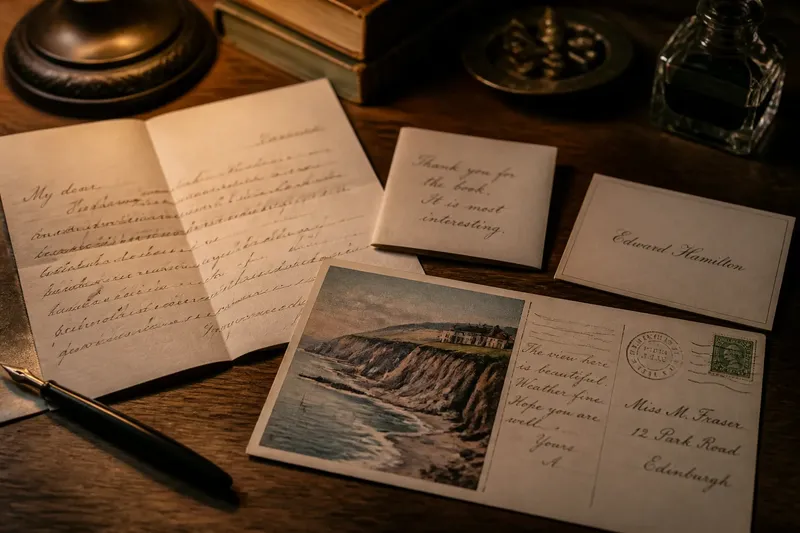
Before the postcard, a greeting on paper might arrive as a letter, a folded note, or a calling card. Each form shaped what a sender could say and what a recipient might expect, from a private exchange to a brief acknowledgment of a visit.
Why could a short greeting feel too formal?
A letter could carry a brief greeting, but its paper, envelope, and careful phrasing might make a few lines feel like an occasion. That could seem mismatched when the purpose was simply to thank someone, acknowledge a visit, or send regards.
Writers adapted the format to the relationship. A folded sheet offered room for a few lines without inviting a long account. A calling card foregrounded the sender’s name and, where local custom permitted, could carry a brief handwritten message. Like containers on a shelf, these forms gave different amounts of room while signaling different purposes.
Imagine a neighbor has lent you a book, and you want to thank them without sharing other news. A short note on a small sheet can say so directly. A longer letter would offer more room than the purpose requires; the note keeps the gesture warm and proportionate.
How did paper greetings ask for a reply?
A written greeting could leave the recipient unsure whether a response was expected. A formal note might invite an answer, while a card left during a visit might simply acknowledge the call. Wording, relationship, and local etiquette all shaped the interpretation.
Writers could make the purpose clearer. “Thank you for the visit” can close an exchange; a question about a relative or a suggestion to meet again gives the recipient a specific opening to answer. Brevity works best when the message still signals what kind of contact it offers.
Postal access and delivery practices varied by place and period, so the ability to send a greeting depended on local circumstances. Where a sender could use the post, a paper message offered an alternative to a personal visit or a verbal message carried by someone else. It still required addressing and delivery, and the reader could handle the sheet, recognize the handwriting, and keep it.
How did the postcard change paper greetings?
The illustrated postcard placed a picture, a short message, and an address within one compact format. The image supplied an immediate subject; the written side gave the sender room for a personal line. Its limited space made a full letter unnecessary for a brief greeting, but left less room for private expression.
Picture and message shared attention, while the address side also had to meet postal needs. A writer might greet the recipient, refer to the image or occasion, and close in a few lines. A picture of a seaside view could set the scene, but a handwritten remark made the card particular to its reader.
A letter could conceal its contents when folded inside an envelope. A postcard left its message exposed to people handling it during delivery. That made it a poor place for sensitive details and a natural fit for compact, ordinary remarks. The image also turned the greeting into something the recipient could take in at a glance.
How can a printed greeting feel personal?
A printed card can feel impersonal when its wording could go to anyone. Attractive design and ready-made language make sending easier, but a sentence about a shared conversation, a familiar nickname, or a specific reason for writing can make the message belong to its recipient.
More words are not always more personal. A short, particular detail can carry more warmth than a crowded block of stock phrases. The image should suit the purpose, too: a playful design may jar with a serious message, while a plain card can leave room for a thoughtful line.
Say a sender wants to congratulate a friend who has just moved. A printed card gives them a starting point; adding a sentence about the friend’s new neighborhood connects the greeting to that person’s life. The result is still brief, but the words do more than repeat the card’s printed sentiment.
Which paper greeting fits the message?
When is a letter better than a postcard?
Choose a letter when the message needs privacy, context, or room for a real conversation. Its folded, enclosed form keeps the contents from being openly displayed during delivery. A postcard is better suited to a brief greeting that can travel in public view.
What does a calling card communicate?
A calling card foregrounds the sender’s identity and the social act of making or acknowledging a visit. It suits a gesture where presence matters more than a long message. Customs vary, so its meaning depends on the setting.
How can a short greeting sound personal?
Name a shared detail or state the purpose plainly, then stop before the note becomes a cramped letter. A concise sentence feels personal when it fits that particular reader and occasion.
Why can a postcard feel less private?
The message is written on an unenclosed surface, so people involved in delivery may be able to see it. Keep sensitive information out of the message and use an enclosed letter when discretion matters.
What does the paper tell us about a greeting?
Each format makes a different social offer. A letter provides room and concealment; a folded note keeps a small exchange manageable; a calling card emphasizes presence and convention; a postcard pairs an image with a brief message visible during delivery. None is simply a better container. Each nudges the writer toward a particular kind of contact.
The choice of paper still helps clarify what a greeting asks of its reader. Before sending one, consider whether the message needs privacy, whether it calls for a reply, and whether a printed image suits the occasion. Those choices can make a few words feel deliberate without making them feel like a formal letter.