Why a Doorway Becomes a Threshold
Why a doorway becomes a threshold depends on where it sits and how people use it. Learn to read the small cues that give an opening meaning.
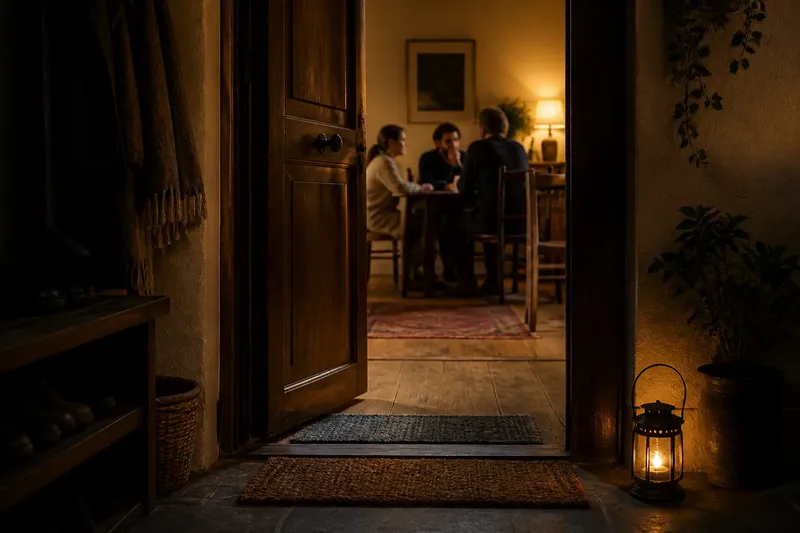
A doorway becomes a threshold when people treat passing through it as more than getting from one room to another. Why a doorway becomes a threshold depends on its position, its use, and the cues gathered around it—not on a universal symbol hidden in the frame.
A plain opening can mark arrival, privacy, permission, or a change in role. These meanings grow from repeated habits and shared expectations. To read one carefully, look at what happens around it, not just at its shape.
1. Position gives the opening a job
Where a doorway sits can shape what people expect from it. An entrance from a street into a home separates public space from private space. A doorway between a kitchen and dining room may connect two parts of everyday life without making either feel restricted. The building’s layout gives the opening a practical role; people can then add social meaning to that role.
Pay attention to what lies on each side. Does one side feel exposed, busy, or shared, while the other feels quiet or personal? Is the opening on a route visitors are expected to take, or does it lead somewhere reserved for household members? The contrast matters more than the doorway’s size or ornament.
These readings are local, not automatic. A gate may welcome visitors in one setting and control access in another. Even within one building, an entrance can feel different to a resident, a guest, or someone arriving for a particular purpose.
2. Repeated use turns passage into a habit
A threshold gains force through the actions that recur there. People may pause to remove shoes, call out before entering, wait for someone to answer, or carry an object across with care. No single gesture has a fixed meaning everywhere; repetition makes it legible to the people who share the space.
Think of a doorway like a bookmark. The paper does not change, but its position helps a reader recognize where to resume. In a similar way, a familiar pause or gesture can help people recognize a transition without anyone announcing it.
Imagine a household where visitors usually knock and wait before entering a back room. A new visitor sees the closed door, knocks, and waits for an invitation; the observable result is that the household’s private area remains distinct from the public visit. The meaning comes from the shared practice, not from a special property of the door.
3. Treatment makes boundaries visible
People often mark an opening through ordinary objects and care. A curtain, mat, sign, latch, or cleared strip of floor can signal how the space should be approached. A worn sill may show frequent passage, while a spotless or carefully dressed entrance may suggest that arrival deserves attention. Such details invite interpretation, but they do not settle it.
Look at how the treatment works in context. A curtain might soften a view, offer shade, or indicate that a room is occupied. A mat could be practical, decorative, or associated with a household routine. Ask what people do with the object and whether its use changes by occasion, rather than assigning it a meaning from appearance alone.
Maintenance is part of the message, too. A door left open may express welcome, convenience, or simply a need for airflow. A closed door may protect concentration or keep noise contained. The same physical choice can carry different meanings depending on who makes it and who is expected to respond.
4. Permission and timing shape the crossing
A threshold can organize who may enter and when. Some openings are crossed freely; others call for a knock, an invitation, or a wait. That small interval gives people room to acknowledge one another and recognize that access is not always assumed.
Notice who controls the timing. A host might open a door for a guest, a worker might wait for a resident’s response, or someone inside might leave a doorway open to invite conversation. These actions make relationships visible. They can also shift: a familiar visitor may be welcomed without a pause, while a formal occasion calls for more deliberate entry.
Do not treat a boundary as proof of a single attitude. A closed door need not mean rejection, and an open one need not mean unrestricted access. Consider the setting, the people involved, and the routine that surrounds the moment.
5. What should you notice at a doorway?
Does the opening divide public and private space?
Notice what each side is used for and who usually has access. The contrast may explain why people pause, knock, or lower their voices there.
What actions happen before someone crosses?
Look for repeated gestures such as waiting, calling out, removing shoes, or carrying something carefully. Their significance comes from the people who use them, not from a universal code.
Which objects or changes draw attention to the boundary?
Consider mats, curtains, signs, lighting, and the condition of the doorframe. Ask what those details help people do before deciding what they symbolize.
Does the meaning change with the occasion?
Compare an ordinary visit with a gathering, a workday, or a moment when privacy matters. If behavior changes, the doorway may be marking a temporary shift rather than a permanent rule.
Read the boundary through the people who use it
A doorway becomes meaningful through a relationship between place and practice. Position sets up a distinction; repeated actions make it familiar; objects and timing help people respond. None of these clues works alone, and the people who share a space may disagree about what an entrance signifies.
For a useful reading, start with observable details: where the opening leads, what people do before crossing, and how they treat it on different occasions. Then hold any interpretation lightly. The best account of why a doorway becomes a threshold leaves room for the people who use it to supply meanings that an outside observer cannot see from the frame alone.